


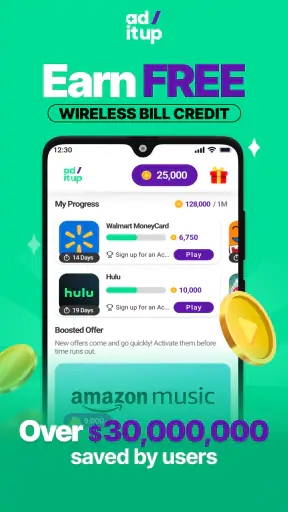
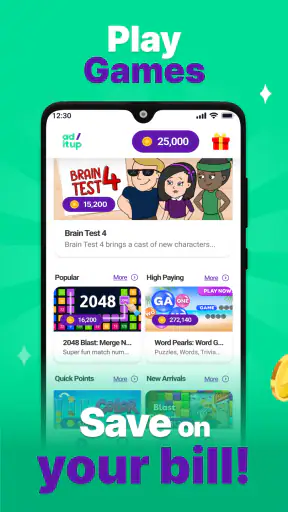
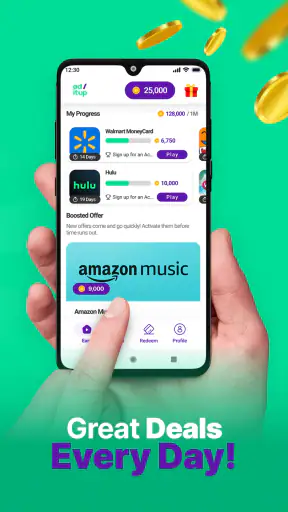
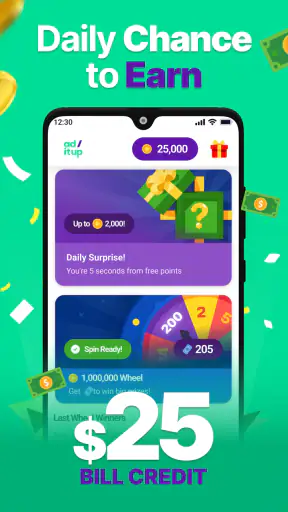
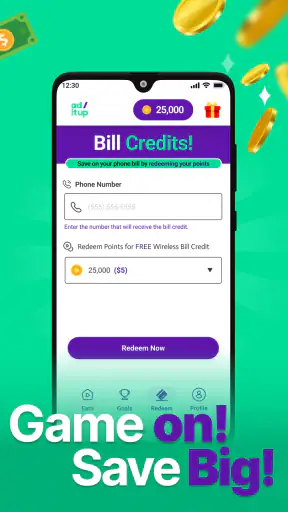
I approached Ad It Up—Save on Your Bills as a shopping app with a simple promise: spend some of your spare time on selected mobile activities and turn that participation into wireless bill credit. That makes it quite different from a normal coupon app. You are not mainly searching for lower prices at checkout; you are building credit gradually through the activities the app presents.
My first impression was that the idea is easy to understand, but the value depends heavily on how deliberately you use it. If you already play casual games on your phone, the app can give that time an extra purpose. If you expect immediate, substantial savings without changing your routine, it is much less convincing. The best way to approach it is as a small, repeatable contribution toward a phone bill, not as a replacement for income or a universal shopping solution.
How the everyday workflow feels
Play2Pay, Inc. positions this free shopping app around wireless bill credit, and the central routine is straightforward. You open the app, look at the available game-related opportunities, choose something that genuinely interests you, and return to it regularly. Progress comes from completing the activities rather than simply installing the app and forgetting about it.
I found that the most sensible starting point is to treat the first session as an orientation period. Instead of selecting the first activity immediately, I would look at how each offer is presented, what action it asks for, and how clearly the app explains the path toward credit. This prevents a common mistake: choosing something that looks attractive but does not fit the amount of time I am willing to spend.
The app is free, and its Everyone content rating makes it approachable for a broad audience. It has been available since July 10, 2019, and its current version is 3.72.00, with an operating-system requirement of 11. That combination suggests a product intended for ordinary, relatively recent phones rather than a specialist tool for advanced users.
A realistic use case is a commuter who has a few short breaks during the day. Instead of opening several unrelated games, that person can use one or two activities from the app during those pauses and keep the resulting credit connected to a practical household expense. The benefit is not that every spare minute becomes highly profitable. The benefit is that an existing habit becomes more organized.
There is also a useful distinction between casual and committed use. A casual user may open the app occasionally, try an activity, and enjoy whatever credit follows. A committed user needs a routine: check the available options, choose one or two manageable activities, and stop when the time cost no longer feels worthwhile. I strongly prefer the second approach because it keeps the app from becoming an endless stream of distractions.
The app’s scale is reassuring. It has passed one million installs, while its average rating sits at 4.7 from about 45,000 ratings. Those figures do not guarantee that every user will have the same experience, but they do indicate that the basic concept has found a substantial audience. I would still judge it by personal usefulness rather than popularity.
What I would do during the first week
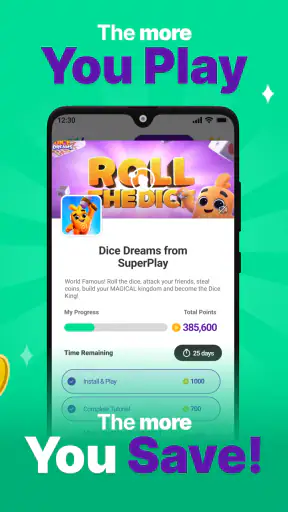
During the first few days, I would test the complete path from opening an activity to seeing how progress is represented. The important question is not merely whether a game is enjoyable. It is whether the instructions are clear, whether the activity fits naturally into my schedule, and whether I can understand what I need to do next without repeatedly guessing.
I would also avoid starting several activities at once. Splitting attention can make it harder to remember which game I chose, what milestone I was pursuing, or whether an action was properly recognized. One activity at a time creates a cleaner personal record and makes it easier to decide whether continuing is sensible.
Another practical habit is to use the app when I already have downtime, rather than creating extra downtime for it. Waiting for an appointment, taking a short break, or relaxing after dinner can all be reasonable moments. Interrupting work, study, sleep, or family time for small bill credit reverses the value proposition.
The strongest baseline workflow is simple: choose carefully, play consistently, check progress, and stop when the time no longer feels worth the credit. That sounds obvious, but it is the difference between a controlled habit and an app that quietly consumes attention.
Settings and phone habits worth checking
Experienced use starts before the first game session. I would check the phone’s notification controls and allow only the alerts that help me return to an activity or notice meaningful progress. Too many prompts can make the app feel demanding, while too few may make it easy to lose track of an activity. The right balance depends on how often I naturally use my phone.
I would also review the app’s account and billing-related screens carefully before committing time. The purpose of the service is connected to wireless bill credit, so it is worth understanding where credit is displayed, how the account is identified, and what steps are expected before treating the balance as useful. I would never assume that visible progress automatically means the bill has already been reduced.
Battery and data habits matter as well. Game activities can be more demanding than reading a coupon or checking a price, especially during long sessions. I prefer using a stable connection and avoiding extended play when my battery is low. That is not a special requirement of this app alone, but it becomes more relevant when the app encourages repeated mobile play.
Privacy-conscious users should take a moment to read the app’s current permission and account prompts rather than accepting everything automatically. I do not see that as a reason to reject the app, but I do see it as part of responsible use. A bill-credit service needs enough information to connect activity with an account, and I would want to know what I am agreeing to before investing time.
My most useful settings habit is keeping the app’s role narrow. I would not let it become the default destination for every gaming decision. I would choose activities through it when the credit opportunity makes sense, then use other games normally when I want a richer or more focused gaming experience. That separation protects the enjoyment of gaming and keeps the financial purpose clear.
Faster patterns that save attention
The quickest users are not necessarily the ones who play the longest. They are the ones who reduce indecision. Before opening an activity, I would decide how much time I have and what kind of experience I want: a brief distraction, a repeatable casual game, or something I can return to over several sessions. This prevents browsing from taking longer than the activity itself.
I would also create a small personal shortlist. If an activity feels comfortable, understandable, and easy to fit into my day, I would return to it rather than constantly chasing every new option. Familiarity reduces setup time and makes progress easier to follow. The trade-off is that a shortlist can become stale, so I would occasionally review whether it still deserves my attention.
A second efficient pattern is to use predictable time blocks. For example, I might reserve a short evening session rather than checking the app repeatedly throughout the day. This makes the habit measurable in a practical sense: I can ask whether the credit feels worthwhile for that block of time. It also prevents notifications from dictating my schedule.
When an activity becomes frustrating, I would not continue merely because I have already started it. That is the sunk-cost trap. The time already spent cannot be recovered, and continuing may produce less value than switching to something more enjoyable or leaving the app alone. Ad It Up works best when I treat every activity as optional.
There is a useful household angle too. If several people share responsibility for a wireless bill, the app can be considered part of a broader savings routine, but I would keep expectations realistic. The credit is most useful when it complements ordinary budgeting, automatic payments, and careful plan selection. It should not become an excuse to ignore a costly phone plan or other recurring expenses.
Where the concept reaches its limits
The biggest limitation is the exchange of time for credit. Even when the activity is enjoyable, it is still an attention-based trade. Someone who dislikes mobile games, has very little free time, or wants direct price reductions will probably prefer a conventional coupon, cashback, or comparison-shopping service.
It is also not the right tool for urgent savings. If my bill is due soon and I need a large reduction immediately, I would contact the carrier, review the plan, or look for a direct discount instead. A gradual activity-based approach cannot replace those actions. The app has more appeal as a background habit than as an emergency financial fix.
Another limitation is that the value of an activity can be difficult to judge at a glance. A game may be fun but require more repetition than I expected. I would pay attention to the point where the experience stops feeling like entertainment and starts feeling like a chore. That personal cutoff is more important than chasing every available opportunity.
The app also should not be confused with a full shopping assistant. Its category is Shopping, but the core experience is centered on earning wireless bill credit through games and related opportunities. If I want to compare product prices, organize grocery coupons, track deliveries, or find the cheapest retailer, I would use a dedicated service designed for that job.
Parents and younger users should still treat the Everyone rating as a broad content classification, not as a promise that every activity suits every child’s habits. I would set clear limits on screen time and make sure the adult responsible for the wireless account understands how the credit process works. The financial purpose belongs to the account holder, even if another family member uses the phone.
Finally, the experience may depend on what opportunities are visible at a particular moment and how well they fit a user’s device, schedule, and interests. I would avoid building a budget around an assumed amount of credit. Consider any result a bonus toward the bill, then evaluate over time whether the routine remains worthwhile.
Who should use it, and who should skip it
I think Ad It Up is a good match for people who already enjoy casual mobile games and want their spare sessions to serve a practical purpose. It is especially suitable for users who can follow a routine without feeling pressured to maximize every minute. The free entry point makes experimenting easy, and the bill-credit angle gives the activity a clearer destination than ordinary gaming.
I would recommend caution for anyone who tends to make impulsive in-app decisions, loses track of screen time, or feels compelled to finish every task once it has begun. The app can be useful only when the user remains in control of the habit. A small credit is not worth sacrificing sleep, concentration, or time that could be spent on a better-paying opportunity.
Someone seeking the highest possible financial return should compare this with work, surveys, cashback services, or direct carrier promotions. Those alternatives may involve different requirements, but they can be more appropriate when the goal is maximizing money rather than making casual gaming slightly more rewarding.
On the other hand, someone who wants a low-pressure way to connect entertainment with a recurring wireless expense may find the concept appealing. I would describe it as a gentle savings companion, not a serious earning platform. That distinction sets the right expectations from the beginning.
My verdict after using the routine
Ad It Up—Save on Your Bills has a focused idea and a clear everyday use case. Play2Pay, Inc. has built an app for people who would play casual games anyway and would rather see that time contribute to a wireless bill than disappear entirely. The approach is more practical than a standard game, but less direct than a coupon or carrier discount.
What I like most is the possibility of turning an existing habit into a repeatable routine without paying to join. What I like least is the temptation to overvalue small credit and spend more time than the result justifies. The app rewards discipline: choose activities selectively, use them during natural breaks, keep notifications under control, and review whether the habit still feels worthwhile.
With roughly 20,000 written reviews and a broad user base, it is clear that many people find the model useful enough to keep around. I would still make the decision based on my own schedule and tolerance for game-based rewards. If I enjoy casual play and want a modest contribution toward my phone expense, I would try it. If I want immediate discounts, predictable returns, or a complete shopping toolkit, I would choose a different kind of app.
My final recommendation is therefore positive but measured. Install it for the specific purpose of testing whether your normal downtime can produce useful wireless bill credit. Give yourself a clear time limit, learn the workflow, and keep the app in its proper place. Used that way, it is a clever addition to a savings routine rather than another source of digital noise.


